
⚡ Join us for the Silver Jubilee episode of our LinkedIn talk show. ⚡
Book a Demo
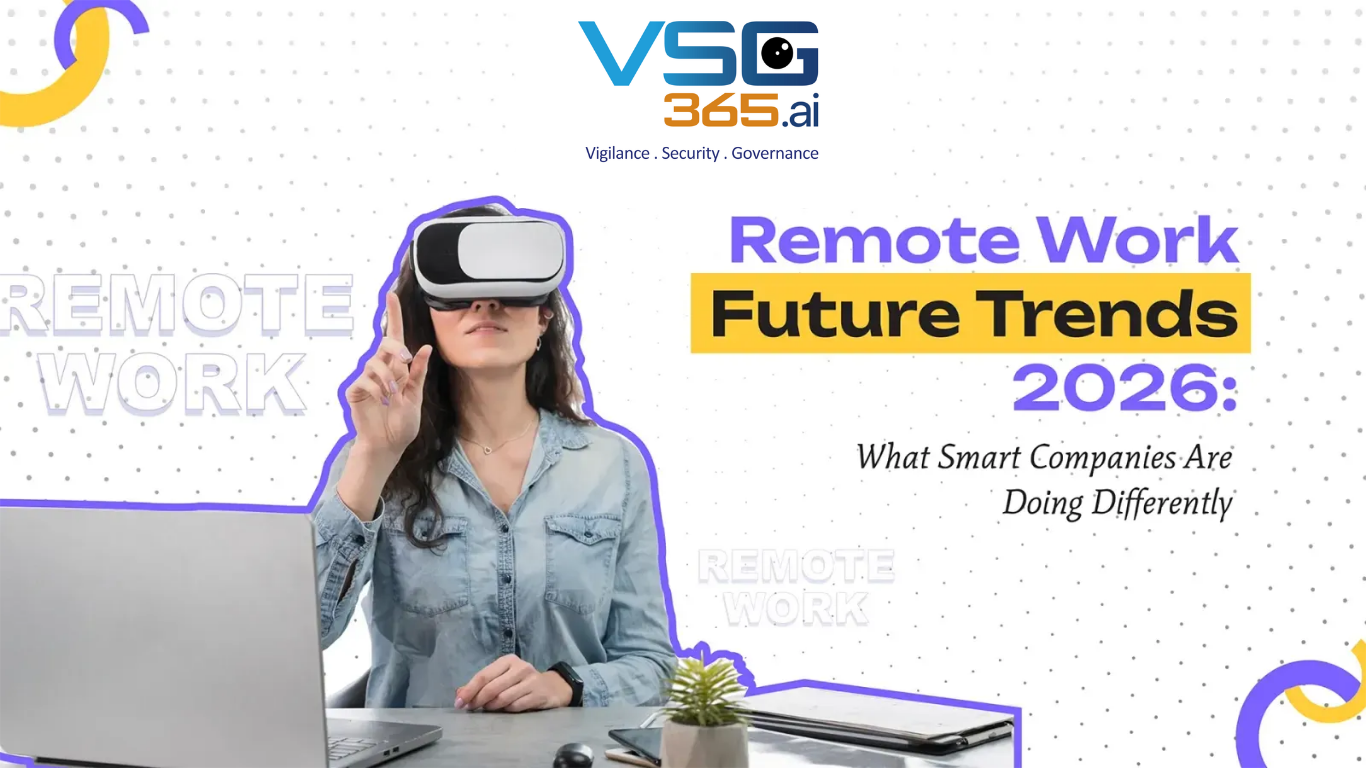
The conversation around remote work has fundamentally shifted. What began as a pandemic-driven experiment has evolved into a strategic business advantage that separates industry leaders from the rest.
As we navigate 2026, organizations that understand and adapt to emerging remote work trends are capturing top talent, boosting productivity, and building resilient operations that transcend geographical boundaries.
This comprehensive guide explores what smart companies are doing differently in the remote work space and how your organization can stay ahead of the curve.
Before diving into specific strategies, let's establish why remote work continues to expand despite predictions of its decline.
The desire for workplace flexibility isn't a passing trend—it's become a non-negotiable expectation. According to recent workforce research, flexible work arrangements top the list of employee benefits, often outweighing traditional perks and bonuses. Organizations that haven't yet embraced flexible work models report significantly higher turnover rates and struggle to attract quality candidates.
The great shift in priorities has been real and lasting. When given a choice between a higher salary with rigid schedules and a competitive salary with flexibility, today's workforce chooses balance. This psychological shift, driven by lessons learned during the pandemic, has created a new employment paradigm where autonomy and time management are valued as highly as compensation.
The productivity question has been definitively answered. Companies managing remote teams effectively report productivity gains of 13-16% compared to their in-office counterparts. Beyond productivity metrics, remote work reduces operational costs (office space, utilities, commute-related expenses) while simultaneously improving employee retention and reducing recruitment costs.
Perhaps the most transformative advantage of remote work is access to global talent pools. Organizations are no longer limited to local hiring markets. This geographic liberation allows companies to source specialists, reduce salary competition by hiring across regions, and build truly diverse teams. For growing companies, this competitive advantage is invaluable.
These aren't experimental approaches; they're proven strategies that leading organizations have already implemented and optimized.
The era of pure work-from-home or pure office-based work has passed. Instead, hybrid work models, combining remote and in-office days, have become the dominant structure in 2026.
Smart companies aren't applying one-size-fits-all approaches. Instead, they're tailoring hybrid schedules to departmental needs. Marketing teams might require three days in the office for collaboration; engineering teams might opt for two. Sales teams often negotiate individual arrangements based on client locations and personal circumstances.
Organizations using asynchronous-first approaches while maintaining strategic in-office days for relationship-building, brainstorming, and complex problem-solving report the highest satisfaction scores among both employees and management.
2. Outcome-Based Performance Management Replaces Hours Tracking
The shift from "where are you?" to "what are you delivering?" represents a fundamental reimagining of management philosophy.
Outcome-based performance management focuses on deliverables, quality, and impact rather than desk time. This approach requires managers to:
3. AI-Powered Workforce Management Optimizes Operations
Artificial intelligence isn't replacing managers; it's augmenting their capabilities. Smart companies deploy AI-powered tools for:
These tools operate behind the scenes, freeing managers to focus on the human elements of leadership: coaching, development, and relationship building.
4. Intentional Remote Work Culture Becomes Strategic Priority
Remote work culture doesn't happen by accident. Leading organizations invest deliberately in building strong cultures despite physical distance.
This includes:
Organizations that treat culture as a strategic initiative rather than an afterthought report 34% lower turnover and dramatically higher engagement in their remote teams.
5. Continuous Coaching and Development Replace Annual Reviews
The annual performance review is dead. In its place, forward-thinking organizations implement continuous coaching and development frameworks.
This includes:
Remote-first companies report that continuous development approaches increase retention by 35% and dramatically improve promotion rates for remote employees.
6. Smart Schedule Adherence Balances Flexibility with Coordination
While outcome-based management emphasizes autonomy, successful remote companies establish clear expectations about availability and collaboration.
Smart schedule adherence includes:
The key distinction is that this isn't about being "always on." It's about being reliably available during agreed-upon windows while maintaining flexibility around how and when individual work gets completed.
7. Personalized Employee Wellness Programs Address Remote-Specific Challenges
Traditional wellness programs designed for office employees miss critical challenges of remote work: isolation, blurred boundaries between work and home life, ergonomic issues, and a lack of informal social interaction.
Smart companies are deploying personalized wellness programs that address:
Organizations investing in these comprehensive programs report 27% lower healthcare costs and dramatically higher employee satisfaction.
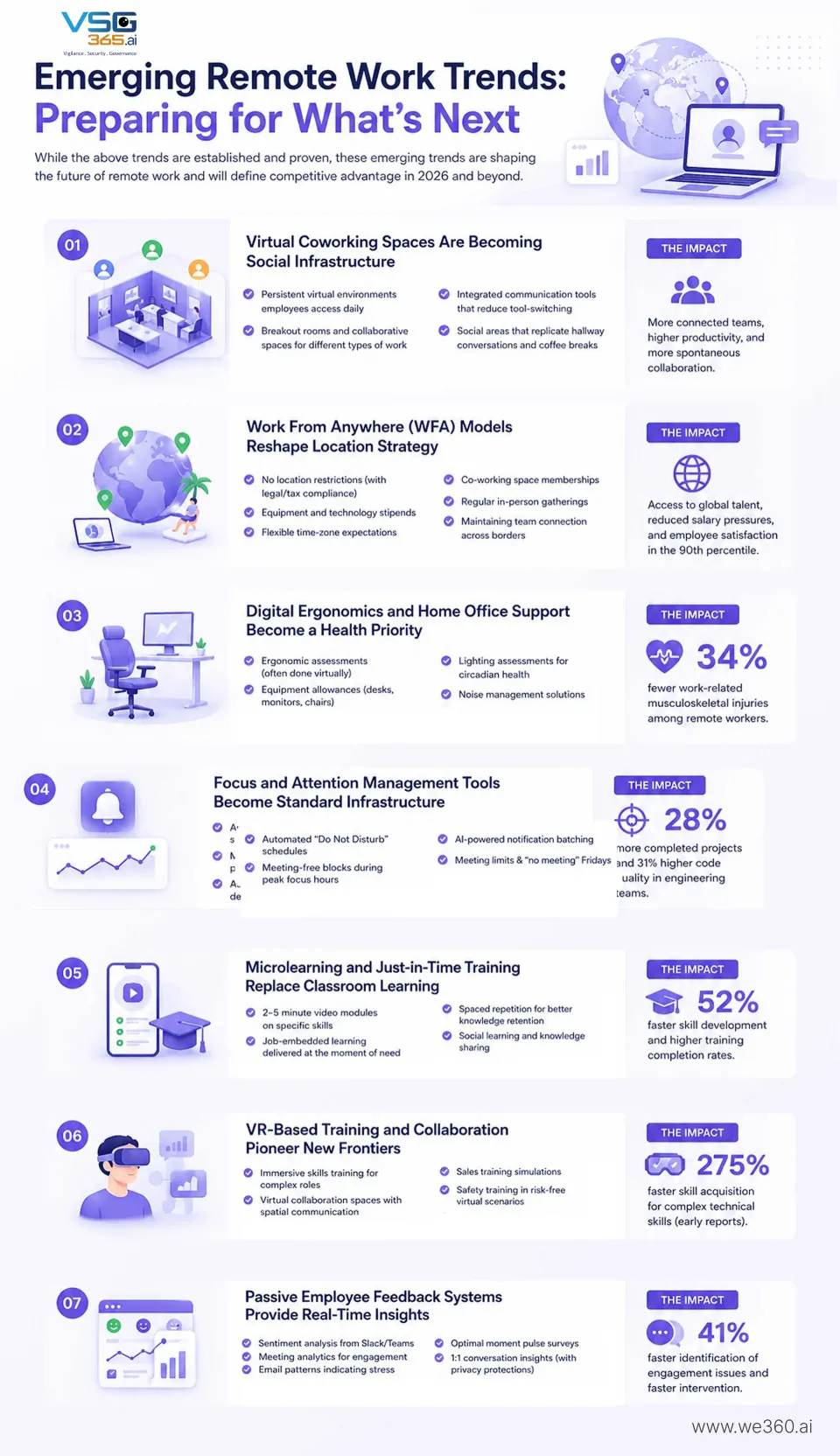
While the above trends are established and proven, these emerging trends are shaping the future of remote work and will define competitive advantage in 2026 and beyond.
1. Virtual Coworking Spaces Are Becoming Social Infrastructure
The next evolution beyond Zoom is virtual coworking spaces—persistent, designed environments where remote workers can collaborate in real-time, replicate serendipitous encounters, and build community.
These spaces feature:
Forward-thinking companies are experimenting with platforms like Spatial, Gather, and Teamflow to create virtual spaces that feel more natural than traditional video conferencing. The result: remote teams report feeling more connected, productivity increases, and spontaneous collaboration opportunities increase significantly.
Related read: Remote Teams: Building Trust and Communication for Success
2. Work From Anywhere (WFA) Models Reshape Location Strategy
Work-from-anywhere programs take remote-work flexibility to its logical conclusion: employees can work from anywhere in the world with minimal restrictions.
True WFA models include:
Companies like GitLab, Automattic, and Zapier pioneered WFA models and report tremendous advantages: access to global talent pools, reduced salary pressures in expensive markets, and employee satisfaction scores in the 90th percentile.
The challenge: managing tax compliance and legal requirements while ensuring employees don't experience isolation. The companies succeeding with WFA have strong infrastructure and clear protocols.
3. Digital Ergonomics and Home Office Support Become a Health Priority
As remote work becomes permanent for millions, companies are recognizing that employee health depends on proper home office setup.
Forward-thinking organizations are implementing:
Companies investing in digital ergonomics report 34% fewer work-related musculoskeletal injuries among remote workers and lower workers' compensation claims.
4. Focus and Attention Management Tools Become Standard Infrastructure
As meeting proliferation and notification overload threaten productivity, smart companies are deploying attention management solutions.
These tools and strategies include:
Teams using attention management strategies report 28% more completed projects and 31% higher code quality among engineering teams.
5. Microlearning and Just-in-Time Training Replace Classroom Learning
Traditional training programs struggle with remote employees. Microlearning—short, focused learning modules delivered when needed—is becoming the standard.
Effective microlearning programs include:
Companies deploying comprehensive microlearning programs report 52% faster skill development and dramatically higher training completion rates.
6. VR-Based Training and Collaboration Pioneer New Frontiers
Virtual reality technology is moving from novelty to a practical tool for training and collaboration, especially for complex or hands-on skills.
Emerging VR applications include:
While still in early adoption, leading tech companies and large enterprises are pilot-testing VR training solutions. Early reports suggest 275% faster skill acquisition compared to traditional training for complex technical skills.
7. Passive Employee Feedback Systems Provide Real-Time Insights
Rather than relying on annual surveys or periodic check-ins, leading organizations are deploying passive feedback systems that continuously monitor employee sentiment and engagement.
These systems capture:
Crucially, these systems maintain strict privacy protections and focus on aggregate insights rather than individual surveillance. Companies using passive feedback report 41% faster identification of engagement issues and faster intervention to address problems.
Understanding emerging trends is one thing. Acting on them is another. Here's a practical roadmap for organizations preparing for a remote-work future.
The foundation of effective remote work management is data. Invest in workforce analytics tools that provide insights into:
Leading organizations implement platforms like Culture Amp, Lattice, or 15Five that provide actionable insights while respecting employee privacy.
Transition from activity-based management to outcome-based systems:
This transition typically takes 6-12 months and requires training managers to lead differently.
Culture doesn't happen by accident in distributed organizations:
Successful organizations treat culture as a strategic priority with dedicated resources, measurement, and accountability.
Culture doesn't happen by acContinuous investment in employee well-being and development pays dividends in retention and performance:cident in distributed organizations:
Organizations investing in holistic well-being programs report 15-25% improvements in retention.
Supporting remote and globally distributed teams requires specific infrastructure:
Many organizations underestimate the infrastructure required for truly distributed operations. Investing appropriately here prevents culture and productivity problems from emerging later.
As we move through 2026, the future of remote work isn't about technology alone—it's about reimagining how we work, manage, develop people, and build cultures at scale.
The smart companies aren't just adapting to remote work trends. They're leveraging distributed work as a competitive advantage. They're building more resilient, globally diverse teams. They're creating better employee experiences. They're improving their financial performance.
The trends outlined in this guide, from outcome-based management and AI-powered workforce optimization to virtual coworking spaces and VR-based training, represent the frontier of how work is evolving. Organizations that understand and implement these strategies won't just survive in 2026. They'll thrive.
The question isn't whether remote work is here to stay. The question is: are you ready to lead in this new era?